



For many of us, the importance of a fire drill is ingrained in us from an early age. Through ongoing rehearsals focusing on calm evacuation procedures, we build muscle memory for what to do in a real emergency. Just as importantly, these drills cement lessons on what not to do. For example, I don’t think the saying goes: “Stop, drop, and grab a coffee before riding in the elevator.”
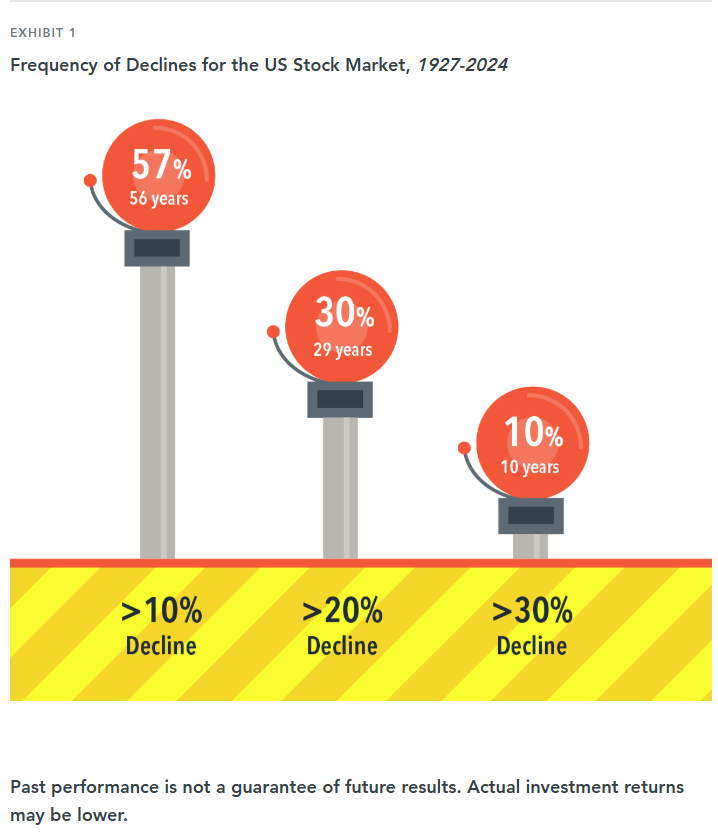
The concept of a fire drill is relevant to investing too. Knowing the range of possible outcomes, and how to behave in those circumstances, is critical to success for the long-term investor. The odds are investors will be tested with a downturn at some point. US stocks, which currently make up nearly two-thirds of global equity markets, have experienced a downturn of at least 20% at some point during 29 of 98 calendar years since 1927.
It’s important to keep in mind that a bad stretch doesn’t mean a bad year is to come. While a 20% slide occurred in 29 years, only six times did the market end up below -20% for the full year. And in 10 of those 29 years, the market actually posted positive full year returns. This reinforces the lesson that the most reliable course of action following a market downturn is to remain invested.
We can’t control – or predict – market drops. What we can do is avoid compounding losses by reacting. Fire drills save lives. Financial fire drills may help save our savings.
Index descriptions
Fama/French Total US Market Research Index: July 1926–present: Fama/French Total US Market Research Factor + One-Month US Treasury Bills. Source: Ken French website.
Results shown during periods prior to each index’s inception date do not represent actual returns of the respective index. Other periods selected may have different results, including losses. Backtested index performance is hypothetical and is provided for informational purposes only to indicate historical performance had the index been calculated over the relevant time periods. Backtested performance results assume the reinvestment of dividends and capital gains. Profitability is measured as operating income before depreciation and amortisation minus interest expense scaled by book. Eugene Fama and Ken French are members of the Board of Directors of the general partner of, and provide consulting services to, Dimensional Fund Advisors LP.
The original version of this article has been reprinted with permission and was written by Wes Crill, PhD Senior Investment Director and Vice President of Dimensional Funds Advisors.
This content is developed from sources believed to be providing accurate information and provided by Dimensional Fund Advisors. Please consult legal, finance or tax professionals for specific information regarding your individual situation. The opinions expressed and material provided are for general information and should not be considered a solicitation for the purchase or sale of any security.